Understanding the Cross: Why Early Christians Avoided It
Today, the cross is unequivocally the most recognizable and revered symbol of Christianity. From towering steeples and church altars to delicate necklaces worn close to the heart and even permanent tattoos, its presence is ubiquitous. Many Christians don the cross in ash on their foreheads during Lent, a testament to its deeply embedded significance in contemporary faith. Yet, this widespread acceptance masks a surprising historical truth: for the first few centuries of Christianity, the cross was largely avoided as a religious emblem by its adherents. Why did early Christians shy away from a symbol that is now central to their faith?
The Cross in the Roman World: A Mark of Utter Shame
To fully grasp the early Christian reluctance, one must first understand the chilling context of the cross in the Roman Empire. For Romans, crucifixion was not merely a method of execution; it was a public spectacle of extreme torture, humiliation, and degradation. It was a punishment reserved almost exclusively for the lowest echelons of society – slaves, rebellious foreigners, and the most egregious criminals. Roman citizens, particularly elites, were typically exempt from such a gruesome fate, and even the word "cross" (crux in Latin) was considered harsh and offensive.
The Roman writer Plautus, for example, used the phrase "go to an evil cross" as a vulgar idiom, akin to "go to hell." Cicero, the famed Roman orator, eloquently captured the horror of the cross when recounting the crucifixion of a Roman citizen, P. Gavius, by a corrupt governor. Despite Gavius's pleas of Roman citizenship, a cross was prepared for him, a sight Cicero described as "an accursed thing" that Gavius had never seen. This incident vividly illustrates that for Roman elites, encountering or suffering crucifixion was exceedingly rare and utterly unthinkable. The act was so repulsive that Verres ordered Gavius to be crucified on the shore facing Italy, a perverse display of power against someone claiming Roman protection.
Contrast this with the grim reality for slaves and the lower classes. A character in a Plautus play grimly accepts his inevitable death by crucifixion, stating, "I know that the cross will be my tomb; there my ancestors have been laid to rest, my father, grandfather, great-grandfather, great-great-grandfather." This chilling line reveals the commonplace nature of crucifixion for those without status, a perpetual threat for even minor transgressions. For Romans, the cross symbolized everything detestable: pain, disgrace, public nakedness, and the ultimate loss of dignity.
Early Christian Avoidance: Beyond Roman Stigma
Given the Roman perception, it's hardly surprising that early Christians would hesitate to adopt the cross as their primary symbol. For them, it represented not just Jesus's death, but a death steeped in the most profound shame imaginable within their contemporary culture. It was the death of a criminal or a slave, a public execution that evoked horror and contempt, not reverence.
- The Shameful Death: Jesus's crucifixion was a Roman public execution, designed to deter others through its brutality and humiliation. To openly embrace the instrument of this death would have been scandalous, potentially even blasphemous, in the eyes of many.
- Focus on Resurrection, Not Execution: Early Christian theology placed immense emphasis on the resurrection of Jesus, celebrating his victory over death rather than dwelling on the instrument of his suffering. Their message was one of hope and new life, not the gruesome details of his execution. While the crucifixion was a foundational event, the subsequent triumph was the core of their evangelism.
- Alternative Symbols: Instead of the cross, early Christians gravitated towards other symbols that carried positive or less controversial connotations. These included:
- The fish (ichthys), an acronym for "Jesus Christ, God's Son, Savior."
- The anchor, symbolizing hope and steadfastness.
- The dove, representing the Holy Spirit and peace.
- The Chi-Rho (☧), an early monogram for Christ formed by the first two letters of "Christ" in Greek.
- The Good Shepherd, depicting Jesus as a protector and guide.
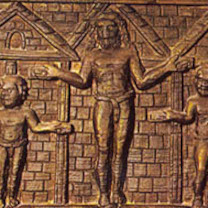
- Lack of Early Imagery: Scholars note the striking absence of crucifixion imagery in early Christian art and archaeological findings. The first widely accepted public depiction of Jesus's crucifixion dates to the fifth century, specifically on the wooden doors of the Santa Sabina Basilica in Rome. This gap of approximately 400 years suggests a deliberate avoidance, indicating that the cross did not function as an original symbol for Christians.
The decision to avoid the cross was not just a matter of social discomfort; it was a nuanced theological stance that prioritized the transformative power of the resurrection over the grim reality of the crucifixion. They were proclaiming a risen Lord, not merely a crucified one.
The Gradual Transformation: From Scorn to Sacred
So, what prompted this dramatic shift? How did an emblem of Roman depravity morph into the universal sign of Christian faith? The journey was slow and complex, deeply intertwined with the evolving theological understanding and political context of Christianity. While early Christians emphasized the resurrection, the theological significance of Jesus's sacrifice on the cross gradually gained prominence as an act of atonement and redemption. The early centuries saw a developing understanding of how Jesus's suffering was integral to salvation, even if the visual representation of that suffering remained sensitive.
A pivotal moment arrived with Emperor Constantine's conversion in the early 4th century. Legend holds that Constantine saw a vision of the Chi-Rho symbol with the words "In hoc signo vinces" (In this sign, you shall conquer) before a crucial battle. After his victory, he began to favor Christianity, and the instruments of Christ's passion, including the cross, began to lose some of their pagan stigma. The cross was no longer solely an instrument of Roman terror but became increasingly associated with the triumph of Christ. Over time, particularly as Christianity became the official religion of the Roman Empire, the stigma of crucifixion faded, replaced by an emphasis on the redemptive power of Christ's sacrifice. The cross transformed from a sign of ignominy into a powerful symbol of divine love, suffering, and ultimately, victory.
To delve deeper into this fascinating evolution, explore How the Cross Became Christianity's Most Popular Symbol and From Roman Shame to Sacred Symbol: The Cross's Journey.
Beyond the Symbol: Interpreting Early Christian Identity
Understanding early Christians' avoidance of the cross offers profound insights into their identity and priorities. It highlights their pragmatic approach to evangelism in a hostile world, choosing symbols that conveyed hope rather than repulsion. It also underscores a theological emphasis that sought to distinguish their faith from pagan practices and Roman imperial power. Their focus on the resurrection was not just a historical event but a declaration of God's ultimate triumph over death and evil, a message far more appealing and empowering than the instrument of a humiliating execution.
Practical Insight: This historical journey of the cross serves as a powerful reminder that symbols are not static. Their meanings are deeply embedded in cultural, social, and theological contexts, and they can evolve dramatically over time. What might be a source of shame in one era can become a revered emblem in another, reflecting changing understandings, political landscapes, and spiritual interpretations.
This nuanced history encourages us to look beyond surface interpretations and appreciate the depth of historical and theological development that shapes our modern understanding of faith symbols. It's a testament to the dynamic nature of religious expression and the resilience of faith to transform even the most abhorrent imagery into a beacon of hope.
In conclusion, the cross, though now the quintessential emblem of Christianity, endured a complex and initially contradictory journey. Early Christians, acutely aware of its horrific connotations in the Roman world, intentionally distanced themselves from it, preferring symbols that emphasized hope, new life, and Christ's triumph. It was only through centuries of theological development, cultural shifts, and imperial endorsement that the instrument of agonizing death was gradually recontextualized and embraced as the sacred representation of redemption and unwavering faith we recognize today.